Compare CPU scikit-learn estimators with GPU-backed cuML equivalents using similar APIs.
| Data | Synthetic classification and clustering datasets |
| Task | Random Forest, KNN, K-Means |
| Framework | scikit-learn + cuML |
| Expected runtime | ~2 min on CPU |
import sklearn, cuml
import numpy as np, matplotlib.pyplot as plt, time
from sklearn.datasets import make_classification
from sklearn.model_selection import train_test_split
from sklearn.preprocessing import StandardScaler
from sklearn.metrics import (
    ConfusionMatrixDisplay, classification_report, confusion_matrix,
)

print(f"scikit-learn : {sklearn.__version__}")
print(f"cuML         : {cuml.__version__}")
scikit-learn : 1.8.0
cuML : 25.04.00
Dataset
X, y = make_classification(
    n_samples=200_000, n_features=20, n_informative=10,
    n_classes=3, n_clusters_per_class=2, random_state=42,
)
X_tr, X_te, y_tr, y_te = train_test_split(X, y, test_size=0.2, random_state=42)
scaler = StandardScaler()
X_tr_s = scaler.fit_transform(X_tr).astype("float32")
X_te_s = scaler.transform(X_te).astype("float32")
y_tr_f = y_tr.astype("float32")
y_te_f = y_te.astype("float32")
print(f"Train: {X_tr_s.shape}  |  Test: {X_te_s.shape}")
Train: (160000, 20) | Test: (40000, 20)
1. Random Forest — sklearn (CPU) vs cuML (GPU)
from sklearn.ensemble import RandomForestClassifier
from cuml.ensemble import RandomForestClassifier as cuRF

t0 = time.perf_counter()
rf_cpu = RandomForestClassifier(n_estimators=100, n_jobs=-1, random_state=42)
rf_cpu.fit(X_tr_s, y_tr)
t_cpu = time.perf_counter() - t0
acc_cpu = rf_cpu.score(X_te_s, y_te)

t0 = time.perf_counter()
rf_gpu = cuRF(n_estimators=100, random_state=42)
rf_gpu.fit(X_tr_s, y_tr_f)
t_gpu = time.perf_counter() - t0
acc_gpu = float(rf_gpu.score(X_te_s, y_te_f))

print(f"{'':20s}  {'Time':>8s}  {'Accuracy':>10s}")
print(f"{'sklearn (CPU)':20s}  {t_cpu:>7.2f}s  {acc_cpu:>10.4f}")
print(f"{'cuML    (GPU)':20s}  {t_gpu:>7.2f}s  {acc_gpu:>10.4f}  (speedup {t_cpu/t_gpu:.1f}x)")
/opt/conda/lib/python3.12/site-packages/cuml/internals/api_decorators.py:317: UserWarning: For reproducible results in Random Forest Classifier or for almost reproducible results in Random Forest Regressor, n_streams=1 is recommended. If n_streams is > 1, results may vary due to stream/thread timing differences, even when random_state is set
return init_func(self, *args, **kwargs)
Time Accuracy
sklearn (CPU) 15.50s 0.9508
cuML (GPU) 1.20s 0.9338 (speedup 12.9x)
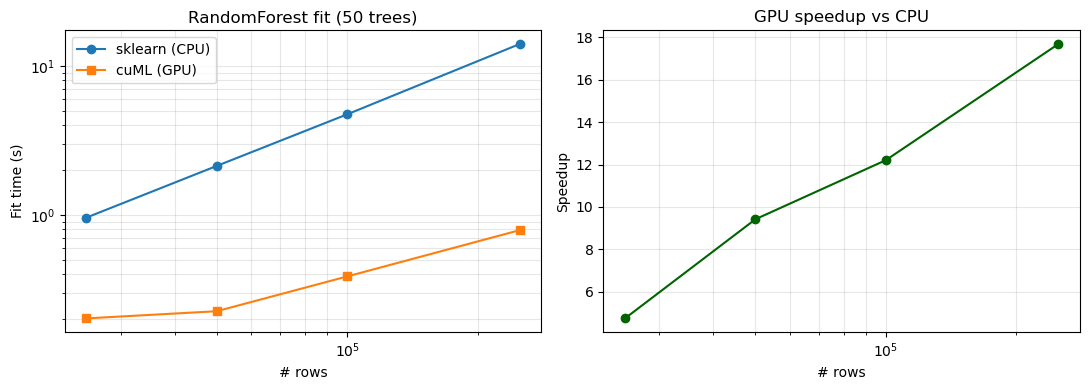
Random Forest scaling — speedup grows with rows
sizes = [25_000, 50_000, 100_000, 250_000]
cpu_t, gpu_t = [], []
for n in sizes:
Xs, ys = make_classification(n_samples=n, n_features=20, n_informative=10,
n_classes=3, n_clusters_per_class=2, random_state=42)
Xs = Xs.astype("float32"); ys_f = ys.astype("float32")
t0 = time.perf_counter()
RandomForestClassifier(n_estimators=50, n_jobs=-1, random_state=42).fit(Xs, ys)
cpu_t.append(time.perf_counter() - t0)
t0 = time.perf_counter()
cuRF(n_estimators=50, random_state=42).fit(Xs, ys_f)
gpu_t.append(time.perf_counter() - t0)
print(f"n={n:>7,d} CPU={cpu_t[-1]:6.2f}s GPU={gpu_t[-1]:5.2f}s speedup={cpu_t[-1]/gpu_t[-1]:5.1f}x")
fig, axes = plt.subplots(1, 2, figsize=(11, 4))
axes[0].loglog(sizes, cpu_t, "o-", label="sklearn (CPU)")
axes[0].loglog(sizes, gpu_t, "s-", label="cuML (GPU)")
axes[0].set_xlabel("# rows"); axes[0].set_ylabel("Fit time (s)")
axes[0].set_title("RandomForest fit (50 trees)"); axes[0].legend(); axes[0].grid(True, which="both", alpha=0.3)
axes[1].semilogx(sizes, [c/g for c, g in zip(cpu_t, gpu_t)], "o-", color="darkgreen")
axes[1].set_xlabel("# rows"); axes[1].set_ylabel("Speedup")
axes[1].set_title("GPU speedup vs CPU"); axes[1].grid(True, which="both", alpha=0.3)
plt.tight_layout(); plt.show()/opt/conda/lib/python3.12/site-packages/cuml/internals/api_decorators.py:317: UserWarning: For reproducible results in Random Forest Classifier or for almost reproducible results in Random Forest Regressor, n_streams=1 is recommended. If n_streams is > 1, results may vary due to stream/thread timing differences, even when random_state is set
return init_func(self, *args, **kwargs)
n= 25,000 CPU= 0.96s GPU= 0.20s speedup= 4.7x
/opt/conda/lib/python3.12/site-packages/cuml/internals/api_decorators.py:317: UserWarning: For reproducible results in Random Forest Classifier or for almost reproducible results in Random Forest Regressor, n_streams=1 is recommended. If n_streams is > 1, results may vary due to stream/thread timing differences, even when random_state is set
  return init_func(self, *args, **kwargs)
n= 50,000 CPU= 2.13s GPU= 0.23s speedup= 9.4x
/opt/conda/lib/python3.12/site-packages/cuml/internals/api_decorators.py:317: UserWarning: For reproducible results in Random Forest Classifier or for almost reproducible results in Random Forest Regressor, n_streams=1 is recommended. If n_streams is > 1, results may vary due to stream/thread timing differences, even when random_state is set
  return init_func(self, *args, **kwargs)
n=100,000 CPU= 4.73s GPU= 0.39s speedup= 12.2x
/opt/conda/lib/python3.12/site-packages/cuml/internals/api_decorators.py:317: UserWarning: For reproducible results in Random Forest Classifier or for almost reproducible results in Random Forest Regressor, n_streams=1 is recommended. If n_streams is > 1, results may vary due to stream/thread timing differences, even when random_state is set
  return init_func(self, *args, **kwargs)
n=250,000 CPU= 14.00s GPU= 0.79s speedup= 17.7x
2. K-Nearest Neighbours — quadratic distance computation
from sklearn.neighbors import KNeighborsClassifier
from cuml.neighbors import KNeighborsClassifier as cuKNN

t0 = time.perf_counter()
knn_cpu = KNeighborsClassifier(n_neighbors=15, n_jobs=-1).fit(X_tr_s, y_tr)
_ = knn_cpu.predict(X_te_s[:10000])
t_cpu = time.perf_counter() - t0

t0 = time.perf_counter()
knn_gpu = cuKNN(n_neighbors=15).fit(X_tr_s, y_tr_f)
_ = knn_gpu.predict(X_te_s[:10000])
t_gpu = time.perf_counter() - t0
print(f"kNN  CPU: {t_cpu:6.2f}s   GPU: {t_gpu:6.2f}s   speedup: {t_cpu/t_gpu:.1f}x")
kNN CPU: 1.61s GPU: 0.19s speedup: 8.5x
3. K-Means clustering
from cuml.cluster import KMeans as cuKMeans
from cuml.decomposition import PCA as cuPCA
from cuml.datasets import make_blobs as cu_make_blobs
from sklearn.cluster import KMeans as skKMeans

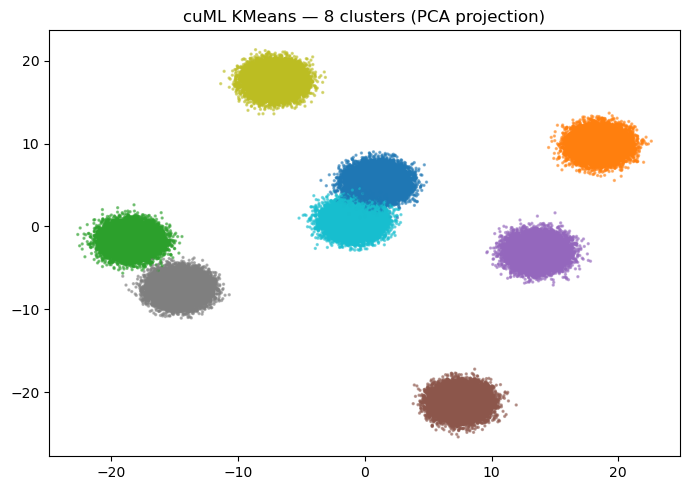
X_gpu, y_gpu = cu_make_blobs(n_samples=200_000, centers=8, n_features=20, random_state=42)
X_cpu = X_gpu.get() if hasattr(X_gpu, "get") else np.asarray(X_gpu)

t0 = time.perf_counter()
skKMeans(n_clusters=8, n_init=3, random_state=42).fit(X_cpu)
t_cpu = time.perf_counter() - t0

kmeans = cuKMeans(n_clusters=8, n_init=3, random_state=42)
t0 = time.perf_counter()
kmeans.fit(X_gpu)
t_gpu = time.perf_counter() - t0
print(f"KMeans  sklearn={t_cpu:6.2f}s   cuML={t_gpu:6.2f}s   speedup={t_cpu/t_gpu:.1f}x")

# 2D PCA projection for visualisation
pca = cuPCA(n_components=2, output_type="numpy")
X_2d = pca.fit_transform(X_gpu)
labels = kmeans.labels_.get()

plt.figure(figsize=(7, 5))
plt.scatter(X_2d[:, 0], X_2d[:, 1], c=labels, cmap="tab10", s=2, alpha=0.5)
plt.title("cuML KMeans — 8 clusters (PCA projection)"); plt.tight_layout(); plt.show()
KMeans sklearn= 0.49s cuML= 0.17s speedup=2.9x